Pick 1 to 4 batters
Openers and top-order anchors are the most fantasy-consistent batting picks. Their strike rate is stable and their boundary bonus potential is high.
New to fantasy cricket? This is where you start. We walk through the contest flow, the points system, team building and a worked fictional lineup so the theory lands as practice.

The contest flow is the same across operators, with minor variations in UI. Knowing the flow before you sign up means you spend less time figuring out the app and more time on your lineup.
Create an account with verified contact details. Most operators require PAN for withdrawals.
Complete KYC: PAN, Aadhaar or equivalent address proof, and a selfie.
Select an upcoming IPL match from the contest list. Each match has a slate of contests.
Pick eleven players within the salary cap. Choose a captain and vice-captain.
Confirm before the deadline (usually the toss). Once locked, swaps are limited to impact-player substitutions.
A balanced XI covers the role types your contest type rewards. The composition matters more than the individual picks; a strong captain on a weak side rarely wins.
Openers and top-order anchors are the most fantasy-consistent batting picks. Their strike rate is stable and their boundary bonus potential is high.
All-rounders unlock lineup shapes that single-skill players cannot. A spin all-rounder gives you batting depth and a spin option.
The split between pace and spin matters at most venues. A pace-heavy lineup struggles on dry, slow surfaces; a spin-heavy lineup struggles on green tops.
Wicket-keeper-batters are a premium role because they earn both batting points and catches/stumpings. Budget for the dual role.
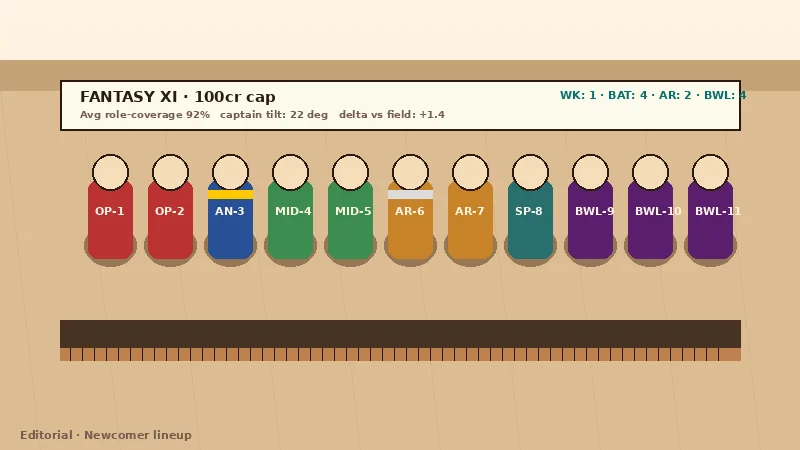
The worked example below takes a fictional budget, picks eleven players within the cap, names a captain and a vice-captain, and walks through the captaincy logic. The example is fictional; the picks do not represent a recommendation.
These are the errors that show up most often in beginner contest reviews. Most are easy to avoid once you can name them.
You will not know the batting order or the bowling plan until after the toss. Lock before the toss and you gamble.
The cap forces trade-offs. A captain-heavy lineup is rarely the right answer in a balanced contest.
Recent points are noisy. Read role, not points.
A lineup built for a small contest is rarely the right lineup for a large contest. Match the lineup to the contest.
The impact-player rule changes lineup shape. A confirmed announcement should change your captaincy call.
A salary-cap contest gives you a budget and asks you to pick eleven players whose combined cost fits within it. A fixed-lineup contest uses the same XI for everyone. Most IPL fantasy contests are salary-cap.
Pick a player whose role is locked, who has high ceiling against the specific opposition and whose batting position or bowling overs are guaranteed. The captain's points are multiplied by two, so role security matters more than form.
The lineup lock deadline is usually the toss of the match. Some operators also allow late swaps for confirmed impact-player substitutions. Check your operator's rules before each contest.
The impact player is a substitution rule introduced by the IPL. Each team names a four-player shortlist before the match; one of the four can be substituted in at any point. The substitution changes your lineup shape.
Open the contest strategy guide for the math of cash contests, GPPs, head-to-heads and multiplier contests.
Read the points-system table, walk through the team-building example, then enter a beginner league. The first contest is about learning the flow, not winning.
Start with the prediction desk and verify the scoring rules before you lock your entry. The verification walkthrough takes five minutes and protects you from phishing apps and unusual permissions.