Captain and vice-captain
Ceiling versus floor. The right captain for a 50/50 contest is rarely the right captain for a 100,000-entry GPP.
Sharpen your decision-making with our strategy and tips section. We cover role security, batting position, overs allocation, contest selection and the avoidable errors that quietly cost fantasy players the most points.
A fresh fantasy tips sheet built from the verified Match 17 preview for Trent Rockets against Sunrisers Leeds at Trent Bridge.
Across thousands of fantasy-cricket contests, three decisions drive the bulk of variance: which captain you pick, which contest you enter and which differentials you select. The guides below focus on those three.
Ceiling versus floor. The right captain for a 50/50 contest is rarely the right captain for a 100,000-entry GPP.
Cash contests reward floor; GPPs reward ceiling. Misalignment between your lineup and your contest is the most common avoidable loss.
Low-owned picks only win when the upside matches the contest size. The differential mindset is a contest-size question, not a contrarian one.
Recent points are noisy. Role is durable. A player whose batting position is locked at number three, or whose bowling overs are guaranteed through the death, will outscore a player riding a hot streak whose role is unstable. The role-first read is the foundation of a defensible lineup.
Stable position, powerplay role, facing the new ball. High floor, moderate ceiling.
Builds the innings, hits the spin matchup, expected strike rate above 140.
Bowling and batting in the last four overs. High ceiling, low floor.
Dual role. Unlocks unusual lineup shapes. Premium budget.
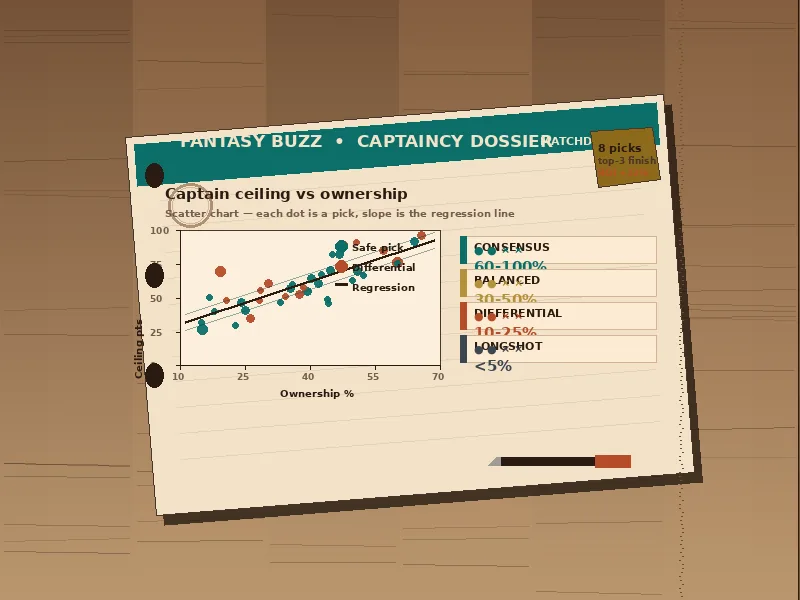
Picking a captain is the high-impact decision in fantasy cricket. The captain's points are multiplied by two, so the variance contribution is enormous. The guide below walks through how to size the ceiling-versus-floor tradeoff for every contest type you might enter.
Ownership tells you where the field is. A player with 60 percent ownership is the consensus pick; a player with 5 percent ownership is a true differential. The math of when ownership helps or hurts is straightforward once you make it explicit.
| Ownership band | What it means | How to use it |
|---|---|---|
| 0 to 10 percent | True differential. | Only in large-field GPPs with room to absorb the floor risk. |
| 10 to 30 percent | Sleeper pick. | Strong in mid-size contests where the field is sharper than the average. |
| 30 to 60 percent | Consensus. | Anchor in cash contests; rarely the captain in GPPs. |
| 60 percent plus | Lock. | Captain only in small contests where the field is thin. |
These are the errors that show up most often in post-match reviews. They are easy to avoid once you see them; the trick is spotting them before locking your lineup.
Lineups locked before the toss assume a particular batting order and a particular bowling plan. A toss that flips the chase can swing your lineup from defensible to wrong in five minutes.
Recent points are noisy. A player with three fifty-point games in a row is not necessarily in form; they may have ridden three soft matchups. Read role, not points.
Some venues reward spin in the middle overs; some reward pace early. A lineup that ignores venue pays for it in dead overs.
Entering a GPP with a cash-contest lineup is the most common cause of "I picked well but did not win." Match the lineup to the contest, not the other way around.
The IPL's impact-player rule can substitute one player from a four-player shortlist. A confirmed impact-player announcement changes your lineup shape and your captaincy call.
Pick a player whose role is locked (a top-order batter at three, an opener facing the new ball, a death-overs specialist whose overs are guaranteed). The captain's job is to convert role into runs; an unstable role adds variance you do not want.
Run at least two distinct lineup shapes. One conservative lineup built around consensus picks, one aggressive lineup built around differentials. Do not enter the same lineup multiple times.
Open the contest strategy guide for the math of cash contests, GPPs, head-to-heads and multiplier contests.
A differential is a player owned by a small share of contest entrants. The math of when differentials pay off depends on contest size and the field's skill.
Yes, the prediction desk publishes captain and vice-captain calls within minutes of confirmed tosses. Subscribe to the news section for the latest.
The captaincy guide and the contest strategy guide are the two high-impact reads on this site. Start with the captaincy guide, then layer in contest strategy.
Start with the prediction desk and verify the scoring rules before you lock your entry. The verification walkthrough takes five minutes and protects you from phishing apps and unusual permissions.